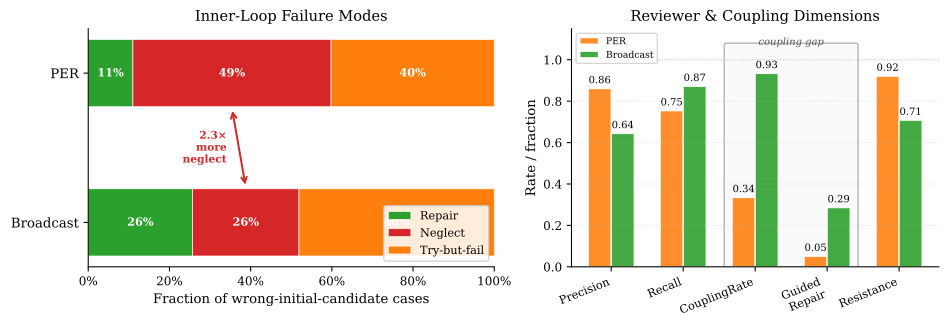
Precise but uncoupled
Critique Uptake
Accepted · NeurIPS 2026 main track
Traces corrective feedback through reviewer detection, the next answer response, and verified repair, showing why accurate review alone need not improve final outcomes.
Research portfolio
I build and evaluate LLM-agent workflows through matched protocol comparisons, trajectory-level failure analysis, task-conditioned memory studies, and cost-aware routing. My industry work adds experiment-grounded preference modeling and DPO/PPO post-training for scientific applications.
Projects & open resources · Updated October 31, 2026
Current research
When should agents work together?
Compare agent protocols, trace reviewer-to-solver critique uptake, and evaluate reasoning quality against inference cost.
Precise but uncoupled
Accepted · NeurIPS 2026 main track
Traces corrective feedback through reviewer detection, the next answer response, and verified repair, showing why accurate review alone need not improve final outcomes.
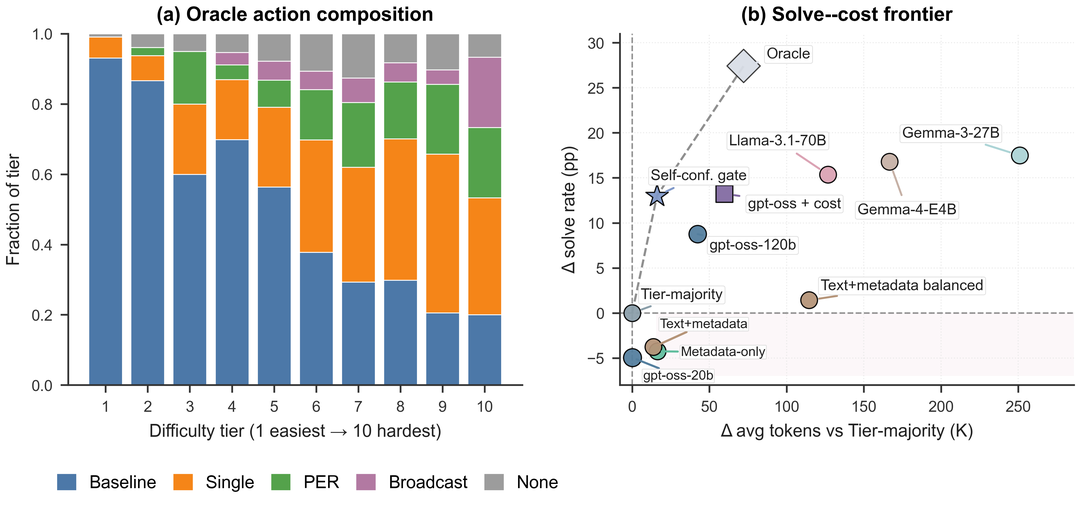
When does collaboration pay?
Published · Findings of EMNLP 2026
Evaluates supervised protocol routing, held-out generalization, and confidence calibration across reasoning tasks. Separates predicting failure from predicting which collaboration protocol is worth its additional inference cost.
Measuring Multi-Agent Scientific Reasoning
Open resource · AIMS @ COLM 2026 workshop accepted
A matched evaluation resource spanning 6,653 problems, two actor models, and four protocols (53,224 trajectories). Structured outcomes and provenance support protocol comparison, critique-uptake analysis, and inference quality-cost evaluation. Source-dataset usage restrictions apply.
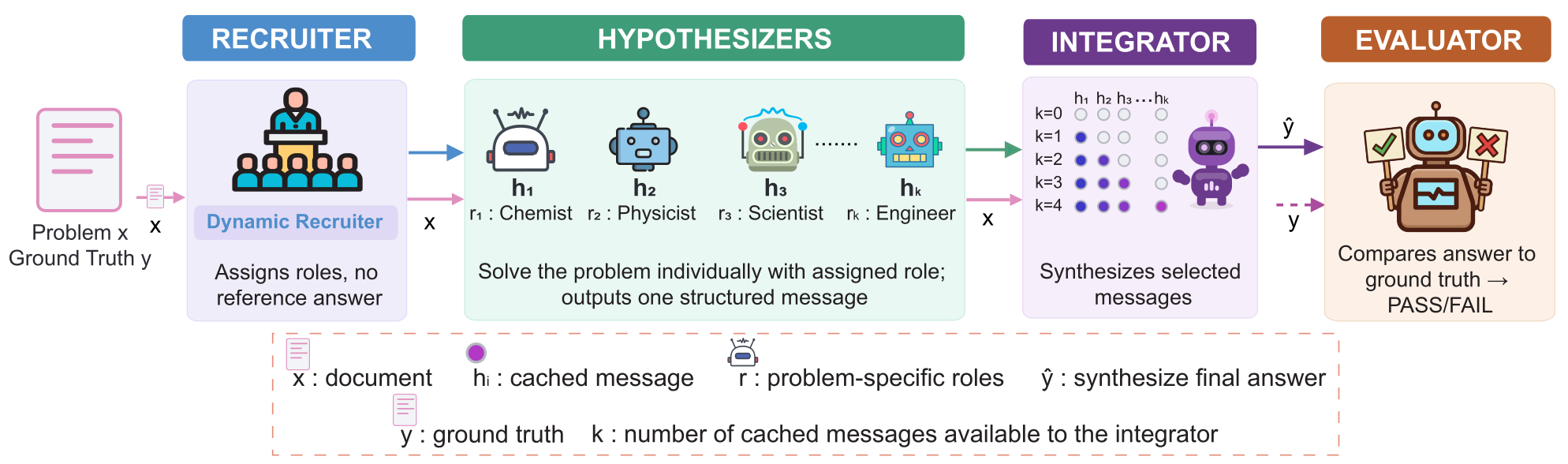
Which messages, at what budget?
Two ICLR 2027 manuscripts under review
Audits which message combinations help a receiver and when another agent's message can be skipped while preserving answers and reducing latency. The work connects message utility, selection errors, and measured inference savings.
Beyond division of labor
AAMAS 2027 manuscript under review
Examines how role instructions, access to evaluator feedback, and revision behavior affect what a multi-agent team does after its first answer is wrong. I am a first author and corresponding author of the AAMAS 2027 submission.
Routing, calibration, and commitment
Public preprint · AAAI 2027 under review
Separates confidence as a routing signal, a probability estimate, and a public answer commitment to diagnose what confidence-guided multi-agent deliberation is actually doing.
What should an agent carry forward?
Measure task-conditioned memory utility and study how agent experience can inform skills and training signals.
What is a memory useful for?
AAMAS 2027 under review · public preprint and artifacts
Measures task-conditioned memory utility using paired with/without-memory evaluations, a frozen reader, and controlled context. Related work studies coding-agent working memory and memory compaction. I am a first author and corresponding author of the AAMAS 2027 submission.
Consolidating a skill library into LoRA
ICLR 2027 manuscript under review
Studies when a self-improving agent should retain retrieved skills in context and when it should consolidate them into model weights, accounting for held-out performance, context consumption, and training cost.
Earlier work
How can AI support discovery?
Build generative, multi-fidelity, and multimodal methods for materials, molecules, and biodiversity.
Generative and multi-fidelity scientific AI
Journal publications · 2021–2026
My Ph.D. work connected generative modeling, molecular language models, reinforcement learning, and multi-fidelity learning to materials and molecular design—from photovoltaic microstructures to organic chemical space.
AI-ready biodiversity at scale
Published · NeurIPS 2024 Datasets and Benchmarks spotlight
A NeurIPS 2024 Spotlight project presenting 161.9 million research-grade images across approximately 366,600 species, along with 40 million captioned training examples, multimodal models, and biodiversity benchmarks. I am a first author.
Research in practice
Earlier research experiences that connect to my current interests. See the CV for appointments and education.
Visiting Scientist at Corteva Agriscience
Trained preference models from scratch with rewards grounded in real experimental outcomes, used DPO and PPO for domain-specific language-model customization, and elicited scientists' preferences when the preference model was uncertain.
AI Resident at X, Google LLC
Developed multi-agent LLM frameworks to study information flow, communication, coordination, and bidding among stakeholders with different interests.
Explore the team and collaboration information, or get in touch.