In preparation · Scientific Data (Nature Portfolio)
SciAgentTrace
A matched cross-domain corpus of scientific-agent protocol executions — released with an execution layer that records what each protocol actually cost to run, not only whether it got the answer right.
Headline figures
- 53,224
- matched trajectories in the core panel
- 6,653
- problems, each run under every model × protocol
- 40
- complete actor-family-protocol cells
- 1,889,265
- ordered trace events in the full package
What SciAgentTrace is
A workload-characterization resource for scientific agents
SciAgentTrace records the same scientific problems being solved repeatedly under different agent protocols, and keeps the operational evidence of each run. It is built to support ML workload characterization and data-centric AI research: the unit of study is the request structure a protocol generates, not just the answer it returns.
The corpus is matched by construction. A single fixed set of 6,653 problems is executed under two actor models and four protocols, producing 53,224 trajectories arranged in 40 complete actor-family-protocol cells. Because every cell sees an identical problem set, differences between protocols can be read without re-weighting for problem difficulty or benchmark mix.
-
matched panel
One problem set, every condition
6,653 problems × 2 actor models × 4 protocols = 53,224 trajectories, with no cell left partially populated.
-
execution layer
Operational evidence, not just outcomes
Client-observed elapsed time on every matched trajectory; token totals and observable model-request counts wherever they can be attributed.
-
provenance
An availability mask, not imputed zeros
Fields that cannot be attributed to a single request stay unavailable and are marked as such. Nothing is filled in with a zero.
| Component | Count |
|---|---|
| End-to-end trajectory records | 68,892 |
| Ordered trace events | 1,889,265 |
| Problems | 7,467 |
| Matched outcome groups | 17,223 |
The full package is broader than the matched core panel: it retains runs outside the strict 6,653-problem matched design. Analyses that depend on matching should use the core panel.
Why it is different
The execution layer
Most agent-protocol datasets record what was said and whether the final answer was correct. SciAgentTrace additionally records what the run cost the serving system, on the same matched design — which is what makes protocol comparison a workload question rather than only an accuracy question.
- Client-observed elapsed time
- Wall-clock duration as observed at the client, recorded for all 53,224 matched trajectories. This is the one execution-layer field with complete coverage across the matched panel.
- Successful-response token totals
- Token accounting for responses that completed successfully, available on 39,918 matched trajectories.
- Observable model-request counts
- The number of model requests visible to the client, available on the same 39,918 matched trajectories. Request count is the field that carries most of the structural difference between protocols.
Why request structure matters
Two protocols can consume a similar number of tokens while issuing very different numbers of requests, and it is the request pattern — not the token total alone — that determines queueing behaviour, concurrency and latency in a serving system. Recording requests and tokens separately, on matched problems, is what lets that distinction be measured instead of assumed.
Dataset composition
Five benchmark families, five scientific domains
The matched problem set is drawn from five established benchmark families spanning competition mathematics through experimental biology and materials science. Each family is carried through all eight model × protocol conditions.
| Benchmark family | Domain | Problems | Trajectories1 | Cells |
|---|---|---|---|---|
| OmniMath2 | Competition mathematics | 4,181 | 33,448 | 8 |
| JEEBench | Pre-engineering science | 515 | 4,120 | 8 |
| SciBench | College science | 574 | 4,592 | 8 |
| LAB-Bench | Biology | 741 | 5,928 | 8 |
| MaScQA | Materials science | 642 | 5,136 | 8 |
| Total | 6,653 | 53,224 | 40 |
1 The per-family trajectory column is derived as problems × 2 actor models × 4 protocols; it sums to the verified panel total of 53,224. ↩
Actor models
-
actor arm 1
Gemma 4 31B
One of two actor models executing every protocol across every benchmark family.
-
actor arm 2 · evaluator
GPT-OSS 120B
The second actor arm, and also the fixed answer evaluator for both arms — so outcome labelling is held constant across the comparison.
Protocols
Four execution protocols
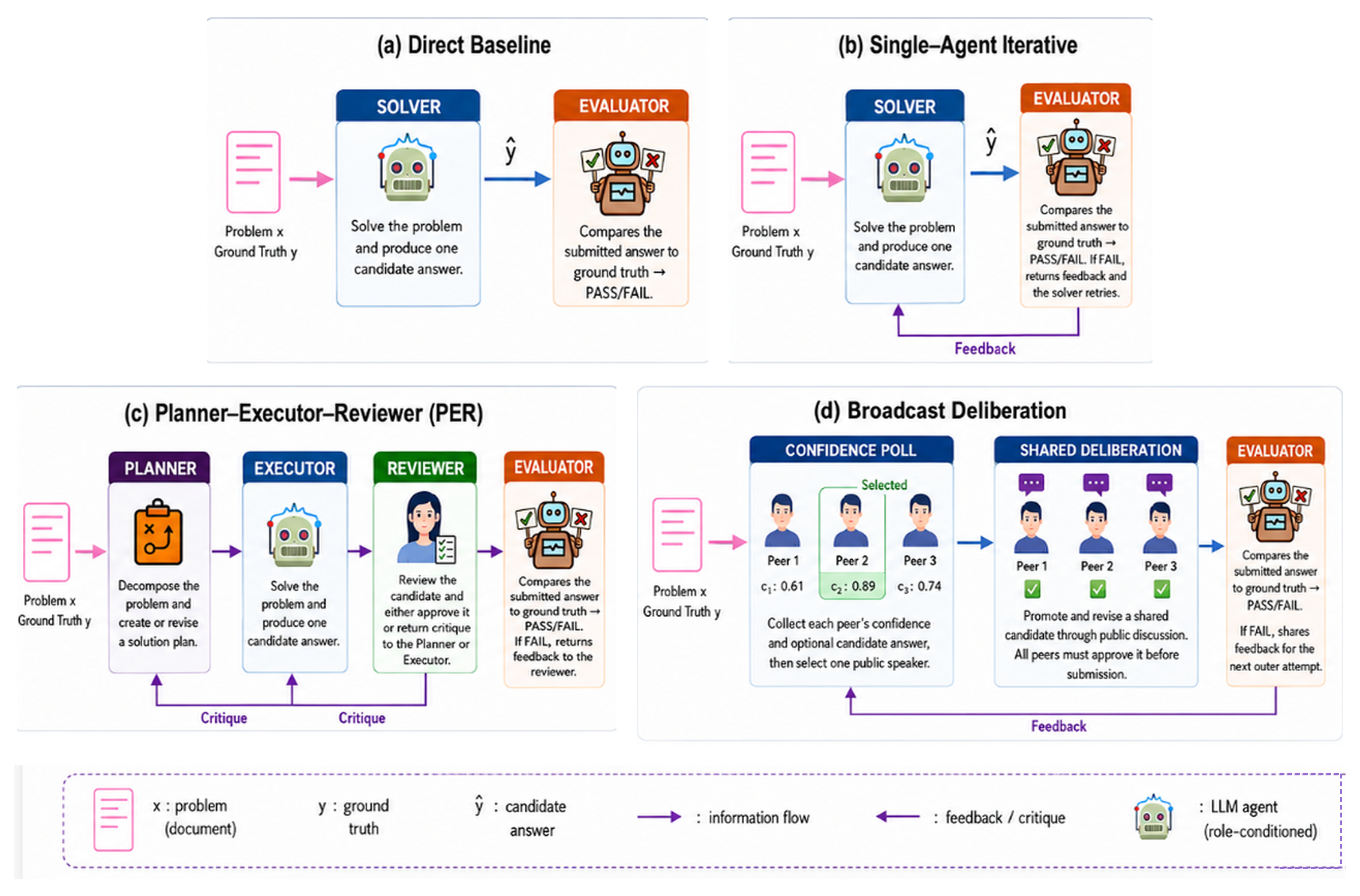
Each protocol is a different way of spending compute on the same problem. They range from a single request to a multi-agent exchange, which is what produces the spread in request structure that the execution layer captures.
-
protocol 1
Direct Baseline
A single pass at the problem with no iteration and no additional roles. This is the reference condition against which the other three are compared.
-
protocol 2
Single-Agent Iterative
One agent revisits and revises its own work across multiple turns, adding requests without adding roles.
-
protocol 3
Planner-Executor-Reviewer (PER)
Work is split across three distinct roles — planning, execution and review — in a structured pipeline.
-
protocol 4
Broadcast Deliberation
Multiple agents exchange messages over a shared broadcast channel before an answer is settled.
Measurement coverage
An audited coverage boundary
Execution-layer coverage is not uniform, and the corpus states exactly where it stops. Elapsed time is complete across the matched panel. Token totals and request counts are available on 39,918 of 53,224 trajectories.
Execution-layer coverage across the 53,224 matched trajectories
- 39,918 trajectories (75.0%) — elapsed time, successful-response token totals, and observable model-request counts.
- 13,306 trajectories (25.0%) — elapsed time only. All are Planner-Executor-Reviewer runs.
Of 53,224 matched trajectories, 39,918 (75.0 percent) carry elapsed time, token totals and request counts; the remaining 13,306 (25.0 percent), all Planner-Executor-Reviewer runs, carry elapsed time only.
| Field | Trajectories covered | Share of panel |
|---|---|---|
| Client-observed elapsed time | 53,224 | 100.0% |
| Successful-response token totals | 39,918 | 75.0% |
| Observable model-request counts | 39,918 | 75.0% |
The PER boundary is audited, not missing
The 13,306 elapsed-only trajectories are Planner-Executor-Reviewer runs. PER's counters accumulate across its roles in a way that cannot be separated into per-request totals after the fact, so token and request figures for those runs are not recoverable post-hoc — this is a property of how the protocol was instrumented, not a gap in collection.
The corpus therefore ships an availability mask and an audit trail recording precisely which trajectories carry which fields. Unavailable values remain unavailable: they are never imputed as zero, because a zero token count is a measurement, and an absent one is not. Any analysis using token or request fields should read the mask and restrict itself to the 39,918 covered trajectories; elapsed-time analyses can use the whole panel.
Workload findings
What the execution layer shows
Two headline results from the corpus. Both are descriptive characterizations of the released workload, not controlled serving-system experiments.
Protocols spend very different amounts of wall-clock time
Measured as equal-family median elapsed ratios against the Direct Baseline, the other protocols range from 1.06× to 6.18× under Gemma 4 31B and 1.55× to 8.38× under GPT-OSS 120B. The spread is wide enough that protocol choice, not model choice alone, dominates the time a workload takes.
Request structure carries information that tokens alone do not
In held-out-problem prediction of elapsed time, adding request count and protocol identity to a tokens-only predictor raises R² from 0.695 to 0.789 for Gemma 4 31B and from 0.773 to 0.803 for GPT-OSS 120B. Token volume is not a sufficient statistic for the cost of an agent workload; how the work is divided into requests matters on its own.
Scope of these figures
These are observational measurements taken on the released corpus under the conditions it was collected in. They characterize this workload; they are not claims about serving systems in general, and no controlled infrastructure comparison is implied.
Access status
Availability
Full public release — no credentials required
The corpus, the code that produced it, and its documentation are openly
available. Anonymous access was verified by unauthenticated HTTPS request
with no token present: the dataset API returns private: false
and Parquet files download directly.
Where to get it
- Dataset
- huggingface.co/datasets/AgentsSci/IEEE2026_BigData_MAS-4-Science-Matching — trajectories, outcomes, matched outcomes, problems, ordered trace events, execution records, registry, and integrity manifests.
- Code
- github.com/ChihHsuan-Yang/IEEE2026_BigData_MAS-4-Science-Matching — the protocol runtime for all four protocols, the trace-processing pipeline, benchmark preparation, and evaluation tooling.
- Paper
- A Data Descriptor is in preparation for Nature Portfolio Scientific Data. Nothing has been submitted to any venue and no DOI exists. A link will be added if and when a record is published.
Load it in one line
from datasets import load_dataset

repo = "AgentsSci/IEEE2026_BigData_MAS-4-Science-Matching"
traj = load_dataset(repo, "trajectories", split="test")
Using it correctly: match problem_uid across the protocols you
compare, name the actor and evaluator, and match the execution configuration
before comparing elapsed time. Preserve unavailable fields rather than
coercing them to zero.
Licensing
Composite terms — there is no single license
SciAgentTrace extends upstream benchmark families that carry different and partly incompatible terms. The corpus therefore cannot be offered under one permissive license, and reuse obligations differ by constituent family.
| Family | Terms | Consequence for reuse |
|---|---|---|
| LAB-Bench | CC-BY-SA-4.0, with an upstream do-not-train request | Share-alike applies. The upstream authors request that the material not be used for training; honour that request. |
| MaScQA | CC-BY-NC-SA-4.0 | Non-commercial only, and share-alike. |
| OmniMath2, JEEBench, SciBench | Upstream benchmark terms apply; see the dataset card | Not yet recorded on this page; must be stated before publication. |
Because the non-commercial and do-not-train conditions attach to specific subsets, users combining families must satisfy the strictest terms in the combination they actually use.
Citation
How to cite
The manuscript is in preparation and has not been submitted; no DOI exists. The entry below is a
@misc{sciagenttrace2026,
  title        = {SciAgentTrace: A Matched Cross-Domain Corpus of
                  Scientific-Agent Protocol Executions},
  author       = {Yang, Chih-Hsuan and Thakur, Rajeev},
  year         = {2026},
  note         = {Data Descriptor in preparation for Scientific Data. Not submitted; no DOI assigned.},
  howpublished = {\url{https://huggingface.co/datasets/AgentsSci/IEEE2026_BigData_MAS-4-Science-Matching}},
}
Placeholders in this block
Author list, canonical URL and DOI are all unresolved. Do not circulate this citation, and do not substitute an author list from a different venue — earlier related submissions used differing author lists, and the list for this venue has not been settled.